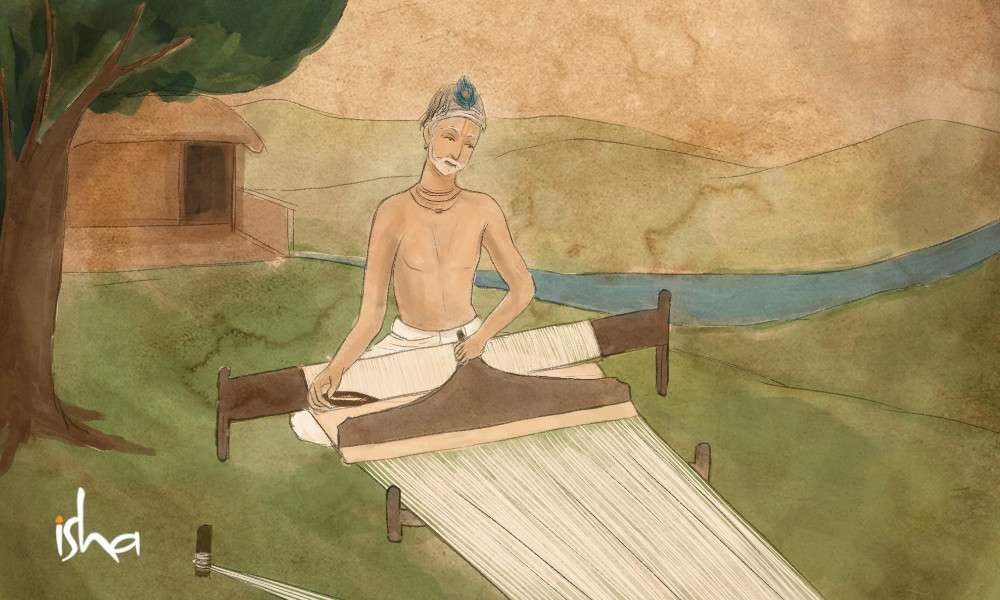
The Waters of Truth: Kabir's Call to Essence
In the words of the mystic poet Kabir, "There is nothing but water at the holy bathing places; and I know that they are useless, for I have bathed in them." This statement challenges the very foundations of ritual and the search for the sacred. Kabir's assertion invites us to reconsider the significance we ascribe to external practices and to seek the deeper essence that lies beyond mere form. In a world often enamored with tradition, his words resonate as a clarion call to authenticity and direct experience.
By declaring the bathing places as "useless," Kabir does not dismiss the value of ritual outright; rather, he compels us to look beyond the surface. The act of bathing, a metaphor for purification and renewal, becomes a poignant symbol of our spiritual journey. Kabir's wisdom urges us to recognize that true transformation cannot be found in external rituals alone but must arise from an inner awakening. This perspective is particularly relevant in contemporary spiritual discourse, where the allure of ritual can sometimes overshadow the essence of direct experience.
The image / the metaphor
The imagery in Kabir's quote is strikingly vivid. Water, a universal symbol of life, cleansing, and renewal, is juxtaposed with the notion of "holy bathing places," which are often revered as sites of spiritual significance. The choice of the word "useless" carries a weighty implication, suggesting that the physical act of bathing in these waters does not guarantee spiritual enlightenment or transformation. Instead, Kabir's experience reveals a stark reality: the external does not equate to the internal, and the sacred cannot be commodified or contained within physical boundaries.
Diving deeper into the metaphor, we find that water represents not only purification but also the fluidity of spiritual understanding. Just as water can take many forms—ice, steam, liquid—so too can our spiritual journeys manifest in various ways. Kabir's declaration serves as a reminder that the essence of spirituality is not fixed; it is dynamic and requires personal engagement. The "holy bathing places" symbolize the rituals and traditions that many cling to, yet Kabir's insight encourages us to seek the deeper currents of truth that flow beneath the surface of these practices.
In the speaker's tradition
Kabir's teachings are deeply rooted in the bhakti tradition, which emphasizes personal devotion and a direct relationship with the divine. This path is characterized by the idea of *kenosis*, or self-emptying, where one relinquishes attachments to external forms and seeks the essence of love and devotion within. Kabir's perspective aligns with the concept of *sunyata*, or emptiness, suggesting that true understanding arises when we let go of preconceived notions and embrace the formless nature of the divine. In this light, his words challenge us to transcend the limitations of ritualistic practices and to cultivate a direct experience of the sacred.
In the *Songs of Kabir*, we find echoes of this sentiment throughout his verses, where he often critiques the superficiality of religious rituals. For instance, he writes about the futility of performing rituals without genuine devotion, emphasizing that the heart's sincerity is what truly matters. This aligns with the broader bhakti ethos, which prioritizes love and devotion over mere adherence to tradition. Kabir's call to authenticity invites us to engage with our spirituality in a way that is deeply personal and transformative.
Living the teaching
Consider a modern scenario where this teaching might resonate: a person attending a religious ceremony out of obligation rather than genuine connection. They may find themselves physically present but emotionally and spiritually disengaged, merely going through the motions of ritual without experiencing its deeper significance. Kabir's insight serves as a poignant reminder that true spirituality cannot be found in the act of attendance alone; it requires an inner awakening and a heartfelt engagement with the experience. This realization can lead to a profound shift in how one approaches spiritual practices, moving from obligation to authentic connection.
In the context of relationships, Kabir's teaching can also illuminate the importance of authenticity. Imagine a couple who routinely participates in social rituals, such as family gatherings or celebrations, yet feels a growing distance between them. If they focus solely on the external expectations of these events, they may miss the opportunity to deepen their connection. By embracing Kabir's wisdom, they can choose to engage with each other more authentically, seeking to understand and support one another beyond the surface of societal norms. This shift can foster a more profound intimacy, rooted in genuine love and understanding.
A reflection
As we contemplate Kabir's words, we are invited to reflect on our own spiritual practices and the motivations behind them. Are we engaging in rituals out of habit, or are we seeking a deeper connection with the essence of our spirituality? In what ways can we strip away the layers of expectation and tradition to uncover the authentic experience of the divine? These questions encourage us to explore the waters of our own spiritual journeys, seeking the truth that lies beneath the surface.




Join the BrightStar Community
Stay connected with daily inspiration, event announcements, and community wisdom