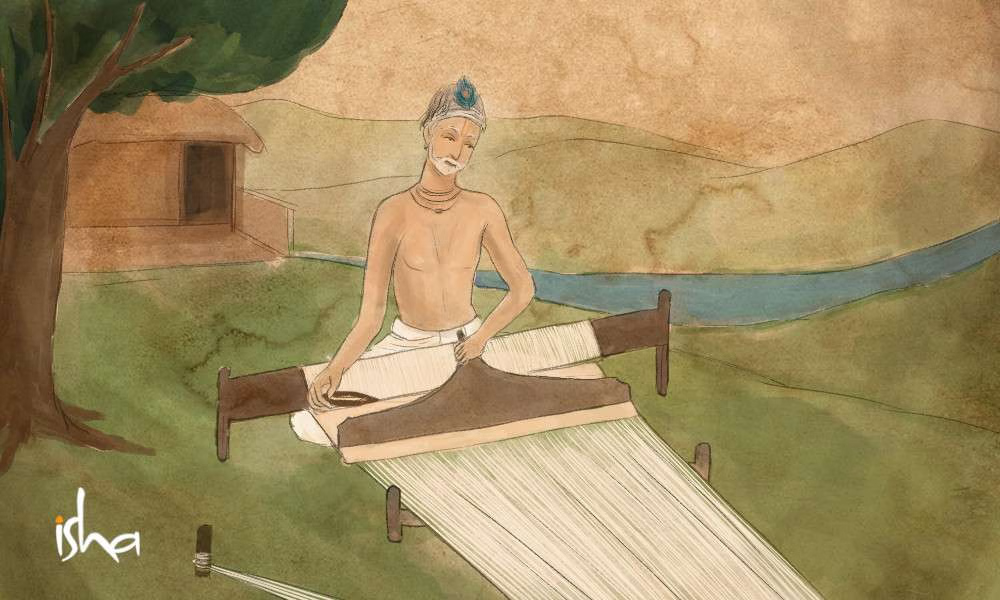
Beyond Ritual: The Essence of Kabir's Wisdom
In the profound words of Kabir, "Neither am I in rites and ceremonies, nor in Yoga and renunciation," we encounter a striking declaration that challenges the very foundations of spiritual practice. Kabir invites us to look beyond the external forms of devotion and discipline, suggesting that true essence lies not in the rituals we perform but in the direct experience of the divine. This assertion holds significant weight in a world often preoccupied with outward expressions of faith, urging seekers to delve deeper into the heart of spirituality.
As we explore this quote, we recognize that Kabir's message transcends the boundaries of specific religious practices, beckoning us to consider the essence of our spiritual journey. In a society that frequently equates spirituality with adherence to rituals, Kabir's words serve as a reminder that the divine cannot be confined to structures or traditions. Instead, he points us toward a more intimate and personal connection with the sacred, one that is unmediated by the trappings of formality.
The image / the metaphor
At first glance, Kabir's statement seems to dismiss the significance of rites, ceremonies, Yoga, and renunciation. The imagery he employs evokes a sense of liberation from the constraints of structured practice. By using the phrase "neither am I," he establishes a clear boundary, suggesting that the divine cannot be contained within the confines of human-made systems. The verbs chosen—"am" and "in"—imply a state of being that is not reliant on external actions or beliefs, but rather on an inner realization of truth.
Diving deeper into the metaphor, we see that Kabir is not merely rejecting these practices; he is inviting us to understand their limitations. Rites and ceremonies, while valuable in their own right, can sometimes become distractions from the true essence of spirituality. Yoga and renunciation, often seen as paths to enlightenment, may inadvertently lead us away from the immediate experience of the divine presence that Kabir so passionately advocates. In this light, Kabir's words become a call to return to the simplicity of direct experience, where the heart meets the divine without the intermediary of form.
In the speaker's tradition
Kabir's teachings emerge from the rich soil of the bhakti tradition, which emphasizes a personal and direct relationship with the divine. Central to bhakti is the concept of devotion that transcends ritualistic practices, focusing instead on love and surrender to God. This aligns with the idea of *kenosis*, or self-emptying, where one relinquishes the ego and the need for external validation in order to experience the fullness of divine presence. Kabir's assertion resonates with the notion of *sunyata*, or emptiness, suggesting that true understanding arises when we let go of attachments to forms and concepts.
In the context of bhakti literature, Kabir's perspective can be likened to the teachings found in the *Bhagavad Gita*, where Krishna emphasizes the importance of inner devotion over mere ritualistic adherence. In Chapter 9, Verse 22, Krishna assures that those who surrender to Him with unwavering faith will be taken care of, highlighting the significance of a heartfelt connection over external practices. Kabir echoes this sentiment, urging us to seek the divine essence that lies beyond the surface of our spiritual endeavors.
Living the teaching
Consider a modern scenario where an individual feels overwhelmed by the expectations of their spiritual community. They may find themselves caught in a cycle of attending rituals and ceremonies, feeling a sense of obligation rather than genuine connection. Kabir's teaching offers a liberating perspective: instead of adhering to these external demands, one can cultivate a personal relationship with the divine through moments of quiet reflection, meditation, or simply being present in nature. This shift from obligation to authenticity allows for a more profound and meaningful spiritual experience.
A reflection
As we contemplate Kabir's profound assertion, we are invited to reflect on our own spiritual practices and the motivations behind them. Are we engaging in rituals and ceremonies out of genuine devotion, or are we merely adhering to societal expectations? In what ways can we cultivate a more direct and personal relationship with the divine, free from the constraints of form? These questions encourage us to explore the depths of our spiritual journey, seeking the essence that lies beyond the surface.



Join the BrightStar Community
Stay connected with daily inspiration, event announcements, and community wisdom